
Content Solutions DocumentationPublished Date: January 26, 2022 Downloaded: April 3, 2026, 11:09 am |
 |
Content Solutions Documentation |
Data Production Process
January 26, 2022
Building Transactive Product Data
This section describes the steps taken to build Transactive Product Data (TPD).
Maintaining Catalog Content
The 1WorldSync Content Solutions process that captures TPD can be used to describe any PC,CE, White Goods or Office Supplies product.
This enables you to easily update your catalog thereby keeping it current and maintaining its relevance. The first step is to place the product into a Class and Category.
1WorldSync Content Solutions uses a two-tier hierarchy with 15 classes containing over 100 categories. New classes and categories can be added seamlessly.
Requests from Pull Customers
A Pull customer is a customer that requests 1WorldSync Content Solutions to build specific SKUs for them. Pull customers include the Channel’s leading distributors, retailers, and manufacturers.
The majority of products added to DataSource™ are added as a result of requests received from Pull Customers.
1WorldSync Content Solutions does not build SKUs basing on what they think the market requires. SKUs are generated as a direct result of requests from members of the channel.
As Pull customers request SKUs that actually exist in their active catalogs, the growth of the 1WorldSync Content Solutions database mirrors the active channel.
Content Production
When 1WorldSync Content Solutions receives a request for a SKU, the manufacturer name of the requested product is mapped to a normalized manufacturer name used within the DataSource™ database. This process ensures that all variations used for manufacturer names appear as one consistent name in the database. For example, IBM, IBM Corp., and IBM Corporation may all appear as IBM in the database.
The manufacturer part number is then mapped against the master catalog of products, where often the requested product has already been treated and can be sent back to the requesting customer the next time distribution takes place.
If the requested product does not yet exist in DataSource™, it is sent to the 1WorldSync Content Solutions data production factory where the product information is researched, captured, standardized, packaged and delivered to the customer.
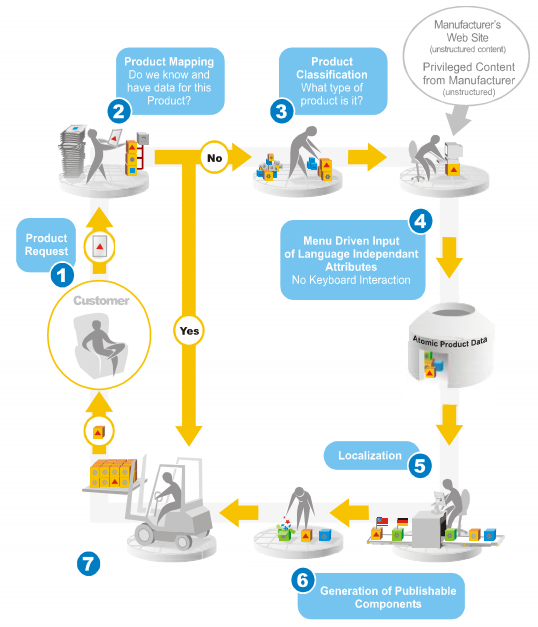
DataSource™ Data Production
The first step in the data production process is to identify the class and category of a requested product. When a product has been categorized, its values are researched for the attributes specific to that category. When the values have been captured, the product is stored as atomic level data.
The atomic-level data is then aggregated in the Data Packaging phase using category-specific generation rules defined within the DataSource™ Distribution System. These generation rules define:
- How atomic data is combined to form:
- Standardized Descriptions
- Main Product Specifications
- Extended Product Specifications
- Which localized data is included:
- Image
- Marketing Text
- Language(s)
- Which subset of atomic data will be included as the searchable attributes.